
Which of the following factors affect thevapor pressure of a liquid? atmospheric
ID: 76953 • Letter: W
Question
Which of the following factors affect thevapor pressure of a liquid? atmospheric pressure addition of solute temperature surface area of the liquid type of liquid amount of liquid Which of the following factors affect thevapor pressure of a liquid? atmospheric pressure addition of solute temperature surface area of the liquid type of liquid amount of liquid atmospheric pressure addition of solute temperature surface area of the liquid type of liquid amount of liquid atmospheric pressure addition of solute temperature surface area of the liquid type of liquid amount of liquid atmospheric pressure addition of solute temperature surface area of the liquid type of liquid amount of liquid atmospheric pressure addition of solute temperature surface area of the liquid type of liquid amount of liquid atmospheric pressure addition of solute temperature surface area of the liquid type of liquid amount of liquid atmospheric pressure addition of solute temperature surface area of the liquid type of liquid amount of liquid atmospheric pressure addition of solute temperature surface area of the liquid type of liquid amount of liquid atmospheric pressure addition of solute temperature surface area of the liquid type of liquid amount of liquid atmospheric pressure addition of solute temperature surface area of the liquid type of liquid amount of liquid atmospheric pressure addition of solute temperature surface area of the liquid type of liquid amount of liquid atmospheric pressure addition of solute temperature surface area of the liquid type of liquid amount of liquidExplanation / Answer
P V = n R TWe will assume that the volume and number of moles in thecooker remains constant (and R is always constant), so wehave: P/T = n R / V = constant
So, at all instances (for the pressure cooker), P/T isconstant,so lets plug in numbers (remember to use absolutetemperature, like Kelvin). I will assume that atmospherictemperature is 25 Celsius (or 298K) (this is what you usuallychoose): (P/T)-initial = (P/T)-final (14.7 psi / 298K) = ((14.7 psi + 12.4psi)/(T final)) T final = 549K
You can then subtract 273 to get this in celsius to get 276degrees (529 degrees F)
However, this would be if there was no liquid present, butmost food is nearly entirely water so you have to use the vaporpressure of water to determine the correct answer. You arelooking for when the total pressure (psia) is 27.1 psi and want toknow the boiling point of water at this temperature (boiling pointis when the vapor pressure is equal to the externalpressure).
Well, I will use a chart but you can be more exact by using aformula such as (where P is in mmHg and T is in Kelvin):
The chart I used is: http://www.engineeringtoolbox.com/docs/documents/926/water-pressure-boiling-temperature.png
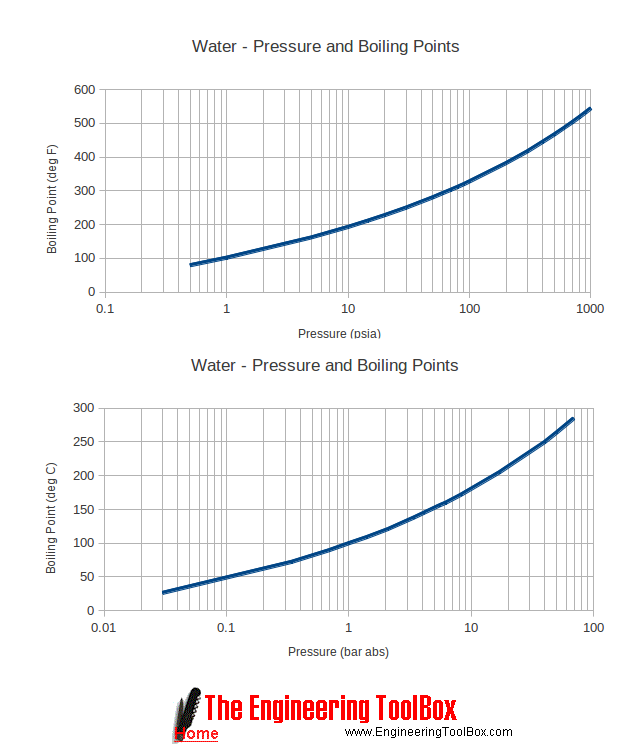
At 27.1 psi, the boiling pointis about 235 degrees fahrenheit
Hope that helps
The chart I used is: http://www.engineeringtoolbox.com/docs/documents/926/water-pressure-boiling-temperature.png
At 27.1 psi, the boiling pointis about 235 degrees fahrenheit
Hope that helps
Related Questions
Hire Me For All Your Tutoring Needs
Integrity-first tutoring: clear explanations, guidance, and feedback.
Drop an Email at
drjack9650@gmail.com
drjack9650@gmail.com
Navigate
Integrity-first tutoring: explanations and feedback only — we do not complete graded work. Learn more.